
What Are the Standard Dimensions of a Bunk Bed?
You’re right to look for “standard” bunk bed dimensions, and the confusion is understandable—there isn’t one set. They vary by configuration. For example, a common Twin-over-Twin is about 41-43 inches wide and 78-84 inches long. Your exact model depends mostly on the mattress sizes you choose, so you’ll always need to match the frame’s internal dimensions for a proper fit. Figuring out which size works for your space is the essential next step.
What Exactly Are the Dimensions of a Standard Bunk Bed?
Now, mattress thickness directly impacts safety rails and overall height. Always check your mattress’s specs against the bed’s listed max. And ladder placement, whether angled or straight, can slightly add to the footprint. Here’s the thing: “standard” just means Twin-over-Twin’s common ranges. For other types, like Twin-over-Full, your width jumps to about 60 inches. The overall length of a bunk bed, typically between 78 and 84 inches, is determined by the bed frame style and mattress size combination. Many bunk beds are constructed from durable wood or metal materials. They are a popular space-saving solution for shared kids’ rooms.
Is Your Ceiling High Enough? Bunk Bed Height & Headroom
Have you ever wondered if that bunk bed you’re considering will actually fit in your room? You need to check your ceiling measurement first.
Here’s the thing: you must factor in height clearance for safety. A top bunk user needs 30 to 36 inches between the mattress and ceiling to sit up safely. Standard ceilings are 96 inches (8 feet). A high bunk bed at 73 inches leaves just 23 inches of headroom—that’s too tight.
You subtract that safety margin from your ceiling height to find your bed’s maximum height. For an 8-foot ceiling, your bunk shouldn’t exceed about 66 inches tall, but low-profile loft beds can be an ideal option for rooms with standard ceilings. Always refer to specific regulatory standards for detailed requirements. Most standard lofted beds fall within a typical loft height range of 5 to 6 feet off the floor. Now, measure your room before you shop.
Twin-over-Twin Bunk Beds: The Most Compact Layout
You’ve measured your ceiling, so you’re ready to explore the most space-efficient bunk layout. A twin-over-twin bunk is your champion for tight space planning, with a typical footprint of just 41-43 inches wide by about 80-83 inches long. It comfortably fits in a room under 100 square feet, and this classic stacked design is often the most budget‑friendly option.
Pay close attention to the manufacturer’s weight limit for each bunk, usually 300-400 pounds. Proper weight distribution is non-negotiable for safety and longevity. You’ll maintain headroom, too, with 38-53 inches of clearance between bunks, excluding mattresses.
Your clear takeaway: This is the most compact vertical stack. It provides two beds in one floor plan, ideal for siblings or guests, and its simple structure works well for various age‑appropriateness guidelines. For a safer and more comfortable ascent, consider models with full‑step stair configurations instead of a traditional ladder. Now, consider if your sleepers need more width. When choosing a model, be sure to compare its safety standards and materials with other top-rated options.

【Space Saving】 This low bunk bed is a great choice for samll room which is low ceiling

Safety-First Design: This twin bunk beds for kids features a 13" high iron guardrail to prevent falls, while the built-in ladder with optimized spacing ensures secure climbing for teens. The sturdy 20-slat structure supports up to 350 lbs per bunk, ensuring durability and peace of mind. Pass the test ASTM F1427-21 Certified, meets rigorous U.S. safety standards for bunk beds

【Upgraded Safety and Convenience】 14.2" high guardrails and a sturdy ladder ensure secure climbing. Designed with hanging hooks and storage pockets to keep the space tidy — bunk bed twin over twin for dorms, cabins, and vacation homes
Twin-over-Full Bunk Beds for Growing Kids and Guests
While you’re considering if a twin-over-twin bunk is too narrow for an older child, a twin-over-full configuration solves that exact space puzzle. It offers a standard 38-inch wide top bunk for a younger kid and a spacious 54-inch wide full mattress below for a growing teen. This is perfect for guest rooms or flexible bedroom layouts. Many models feature built‑in stairs for safer and easier access compared to ladders. When shopping, prioritize models with safety certifications from recognized organizations to ensure rigorous testing for stability and guardrail strength. Always confirm the bunk bed weight capacity to ensure it safely supports all sleepers.
Your space planning must account for its larger footprint. You’ll need a minimum floor space of about 81 inches long by 57 inches wide. Always verify at least 8-foot ceilings for safety and comfort on top. This design efficiently serves two sleepers of different sizes.
Now, you’ve got comfort for an older child below. So, when does a full mattress on top also make sense?
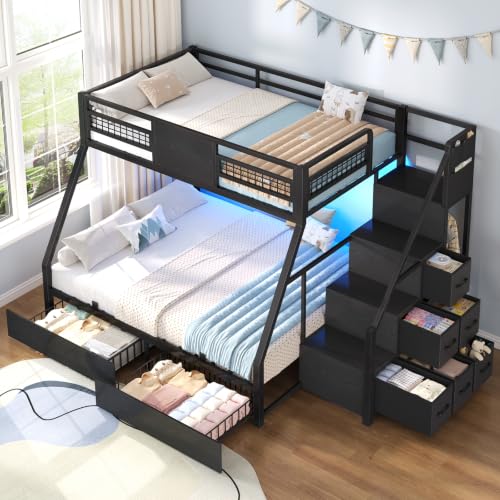
Space Saving Twin Over Full Bunk Bed: Maximize your floor space with this smartly designed bunk bed that fits a standard Twin mattress on top and a Full mattress on bottom. Perfect for siblings of different ages, shared children's rooms, or guest rooms – the upper bunk is ideal for a child while the spacious Full bottom comfortably accommodates a growing teen or overnight guests. Say goodbye to cramped quarters and hello to versatile sleeping solutions.

Space Saving Twin Over Full Bunk Bed: Maximize your floor space with this smartly designed bunk bed that fits a standard Twin mattress on top and a Full mattress on bottom. Perfect for siblings of different ages, shared children's rooms, or guest rooms – the upper bunk is ideal for a child while the spacious Full bottom comfortably accommodates a growing teen or overnight guests. Say goodbye to cramped quarters and hello to versatile sleeping solutions.

Floor Bunk Bed: Tailored to optimize space, this bunk bed features a twin bed atop a full-sized one, making it a smart choice for those who need versatile sleeping solutions. The floor bunk configuration allows your kids to get in and out of bed easily
Full-over-Full Bunk Beds: Roomier Comfort for Teens
Here’s the thing, these bunks have a larger footprint. Expect an assembled frame around 57.5″ wide and 81.5″-102.75″ long. Height also increases markedly, sometimes to 90″, so you must check your ceiling heights. Most models support 400+ lbs per bunk. You’ll need that clearance for the top bunk’s taller guardrails. A versatile, high-capacity sleeping solution can be further enhanced by selecting the right trundle mechanism. Now, what if you want something even larger? Premium solid-wood models like the Heritage with integrated storage can combine adult-sized comfort with valuable space-saving organization. When selecting a model, prioritize safety standards and sturdy construction to ensure it meets family needs.

✅ Sturdy Metal Bunk Bed – Made from high-quality, rust-resistant metal with electrostatic powder coating for long-lasting durability, supporting kids, teens, and adults.

【Heavy-Duty Metal Construction & Weight Capacity】This Full XL Over Queen Bunk Bed supports up to 350 lbs on the upper bed, 450 lbs on the lower bed, and 350 lbs on the trundle, ensuring superior durability and stability for teens and adults.

1. [Staircase with Hidden Storage]: The integrated side staircase provides safe, easy access to the top bunk while transforming each step into a spacious storage drawer, maximizing your room's organization. If there is any problem, please visit our website Merax.com or contact us via this email: csr@merax.com
What About Twin XL, Queen, and Larger Bunk Beds?
All right, you’re wondering about bunk beds sized for taller teens or adults. Twin XL adds five vital inches length over a standard twin, hitting 80 inches long. For Adult Configurations, you’ll often see Twin XL over Twin XL or even Twin XL over Queen setups. Space Considerations become paramount here; a queen bottom bunk needs about 63 inches width. These designs prioritize comfort over compactness, fitting taller sleepers. When considering a queen‑size bunk bed, look for models that incorporate built‑in stairs for enhanced safety and easier access compared to traditional ladders. It is crucial to verify the weight capacity and construction materials to ensure long-term durability for adult use. Many adult bunk beds offer a space-saving benefit while still accommodating larger mattresses. Always measure your frame’s inside dimensions before buying those larger mattresses to guarantee safety and fit. Your next step is figuring out if these proportions work in your actual room space.

【Durable Solid Wood Construction】- Crafted from high-quality solid pine wood and reinforced MDF, this twin-over-twin bunk bed ensures exceptional stability and long-lasting durability. The robust frame supports up to 600 lbs per bed, making it ideal for kids, teens, or guest rooms. Natural wood slats eliminate the need for a box spring while preventing mattress slippage.

【Saves Space & Clean】This Twin XL Over Queen bunk bed is expertly designed to maximize both space and functionality. It features a strategic 9.8-inch clearance underneath the bottom bunk, offering a discreet and convenient spot to store bins or boxes, helping you keep the room tidy. By providing two sleeping tiers in one compact footprint, it perfectly solves the space puzzle for growing families or shared rooms, delivering a practical and smart solution for accommodating multiple children without sacrificing precious floor area.

🏆🏆【Spacious Twin XL Over Queen Design for Families & Guests】This twin XL over queen bunk bed maximizes space without sacrificing comfort, making it perfect for shared bedrooms, guest rooms, or vacation homes. The lower queen bunk bed comfortably accommodates adults or couples, while the upper twin XL bunk is ideal for kids, teens, or overnight guests. It’s a versatile solution that adapts to growing families and changing needs.
Measuring Your Room: A Step-by-Step Fit Guide
Finally, don’t forget ceiling height! You’ll need at least 96 inches total to allow for the bed’s height and the mandatory 30-36 inches of headroom above the top mattress. Grab your tape measure and confirm these three dimensions first. For the lower bunk, ensure there is adequate clearance for sitting up comfortably by measuring the space between the mattress and the floor. Always verify the bed’s overall weight capacity to ensure it can safely accommodate all sleepers.

【Low Bunk Beds】Overall Product Dimension: 79.53''L*43.63''W*44.45''H. Our bunk bed twin over twin is suitable for those families who has low ceilings, and also fit those have multi-members, low bunk beds top bed it isn’t so high for whom on the top bunk and whom on the lower bunk is close enough to the floor that no worry about her/him getting hurt.

【SOLID & STURDY BED FRAME】Constructed by 100% solid pine wood with white paint finish, this kids loft bed features 1 center beams, full-length guardrail and wood slat support, all these enhance this full loft bed load capacity to 264.55 LBS

【Low Bunk Beds】Our bunk bed is suitable for those families who has low ceilings, and also fit those have multi-members. Low bunk beds top bed it isn’t so high and the lower bunk is close enough to the floor that no worry about her/him getting hurt.
Final Step: Your Pre-Purchase Bunk Bed Checklist
Now, you’re trying to wrap your head around everything to check before you buy, right? First, revisit that ceiling height. You’ll need at least 8 feet for standard models to prevent top bunk head injuries. Confirm the mattress size fits the frame’s exact dimensions—a twin is 38 by 75 inches, a full is 54 by 75.
Next, verify the weight capacity specs. The top bunk often supports 200-400 pounds. Guarantee it has a guardrail at least 5 inches above the mattress and a secure ladder. Look for an ASTM safety certification label. Finally, plan your maintenance. You’ll need the correct assembly tools and should establish an annual inspection schedule for bolt tightening. This checklist secures your purchase fits safely and lasts. Your final step is comparing these specs against your room measurements and needs.