Twin Bunk Bed Vs Full Bunk Bed: Which Is Right for You?
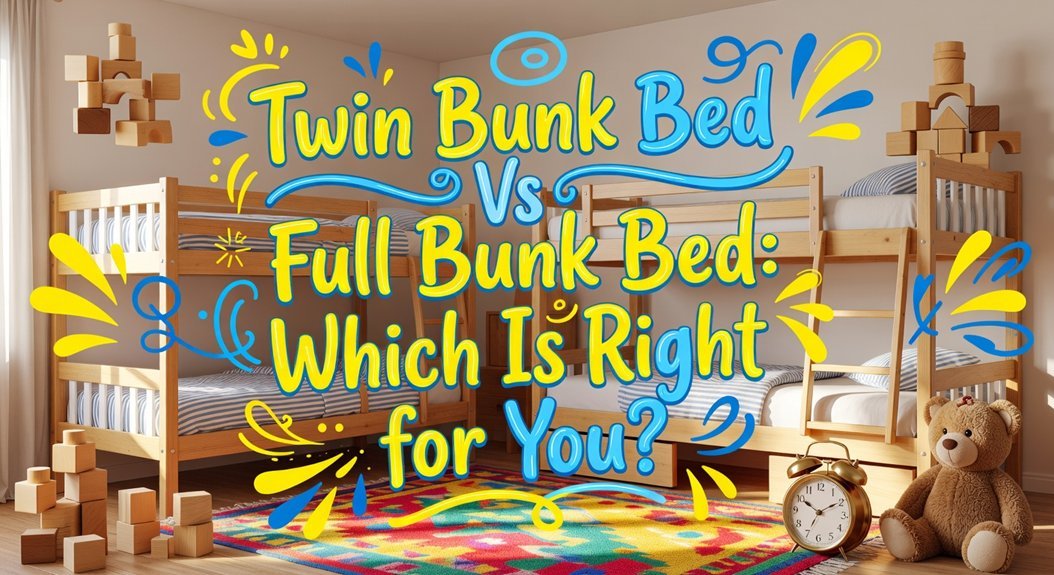
You’re deciding between a twin or full bunk bed—a smart move that hinges on two things: your room’s size and who’s sleeping there. A twin-over-twin is the space-saving champ, freeing up floor area and fitting two beds in under 42 inches wide, perfect for kids. A full-size bottom bunk offers more grown-up comfort but needs about 60 inches of width, so it’s better for teens or shared guest rooms. Your choice balances compact efficiency versus long-term versatility.
How to Choose Between Twin and Full Bunk Beds
When you’re trying to pick between twin and full bunk beds, you’re really deciding between saving space and gaining comfort, which is the core of this whole choice. It starts with your room’s size. A twin bunk is only about 42 inches wide, a true space-saver. A full bunk, at nearly 60 inches wide, needs substantial floor space. You must check your room dimensions first, and remember that the total length including the frame is key. Now, always verify a model meets safety standards for guardrails and ladders. This is non-negotiable. Think about who’s sleeping there and for how long. A twin suits a single child. A full gives a teen or adult that precious extra width. Your choice should also consider decor cohesion; a bulky full bunk can dominate a small room’s layout. Additionally, consider the loft height, as the sleeping platform height is crucial for safety and comfort. You should also confirm the model’s weight limits to ensure it can safely accommodate the intended sleepers. Your main takeaway? Measure your space rigorously, then match the bed to the sleeper’s long-term needs. Next, you’ll want to break down the exact size dimensions.
Twin vs Full Bunk Beds: Breaking Down the Size Dimensions
Breaking down the exact dimensions feels like reading a furniture blueprint, but it’s the key to making your decision. You’re looking at a fundamental width difference. A twin bunk is 41-43 inches wide, fitting a standard 38”x75” mattress. A twin-over-full frame, however, spans 56-60 inches wide for its 54”x75” bottom mattress. That’s a major footprint shift. Your mattress compatibility is essential, especially for safety on top. You must limit top bunk mattress thickness to 8 inches, regardless of the lower bunk’s size. The structural materials are similar, but the full frame’s wider base often provides a more stable feel. For families prioritizing organization in a shared room, many models include built‑in storage like drawers or shelves to maximize the footprint. Simply put, you’re choosing between a space-saver and a roomier sleeper. Think about who’s using it and your room’s true width. This makes twin bunks a classic cost‑effective sleeping solution for kids or guests. Next, consider how these sizes impact your budget and available floor space. When selecting the mattress size, always verify the frame clearance against the manufacturer’s specifications.
Which Bunk Bed Saves You More Space and Money?
Steering the trade-off between space and money in bunk beds can feel like a puzzle, but you’ve hit on the perfect question. For pure Space Efficiency, you’ll want a twin-over-twin bunk. Its narrower design, around 81.5” long by 57.75” wide, maximizes vertical space and frees up 20-35 square feet of floor space compared to two separate twins. This creates more room for play or study in a compact bedroom or dorm. Many modern twin-over-twin bunks are designed with built-in stairs that offer safer and easier access than ladders. For families considering bunk beds, safety and future adaptability are also crucial factors to weigh alongside space and cost. You can further customize this classic twin-on-twin layout with different ladder placements and integrated features.
That model also wins on immediate Financial Savings. Twin bunks cost less upfront because they use less material and are simpler to construct. You’ll spend markedly more for a full-size bottom bunk, though you get extra sleeping space. So, if your priority is maximizing a small room on a budget, a twin bunk is your clear choice.
Comparing Assembly and Setup for Twin and Full Bunks
Now, a full bunk demands more. You’ll need friends to lift heavier frames through doorways, and sturdier tools for its robust build. That obviously takes more time. Before you start, clear the work area and follow a step‑by‑step order of disassembly, beginning with a precise material and tool checklist from your chosen guide. A twin-over-full hybrid mixes both experiences. Always finish with a thorough safety inspection to ensure stability before adding any mattress.
Your key takeaway: twin assembly is a straightforward project, while full bunks are a committed undertaking. Consider how easily you can move components alone before you decide.
Who Is a Twin Bunk Bed Best Suited For?
From the straightforward assembly of twin bunks, we can look at who typically benefits most from their compact footprint. You’re optimizing every square foot in a small apartment or shared kids’ room. Their space optimization is key, fitting two beds in a floor area under 40 inches wide. Now, your target demographics are pretty clear. They’re ideal for children, with built-in guardrails and that standard 38×75 inch twin mattress, often making them a perfect choice for traditional stacked configurations. Many top models also include integrated storage options such as drawers to further maximize room functionality. But don’t assume it’s just for kids. Sturdy, metal-framed models with high weight capacities work for adults in guest rooms or budget-conscious rentals. When evaluating options, always confirm the model’s weight limits and guardrail design for long-term safety and suitability.
When Does a Full Bunk Bed Make More Sense?
It sounds like you’re trying to figure out when the bigger footprint of a full bunk bed actually pays off. It makes the most sense in three key scenarios. You’ll want one for older kids, teens, or adults sharing a room, as the generous full-size mattresses provide real comfort. Its superior weight capacity, supported by sturdy hardwood or metal frames, reliably handles daily use, and you should verify that any model you choose meets all current safety standards for bunk beds. It’s perfect for rental optimization, too, efficiently hosting multiple guests or maximizing occupancy in a vacation property. Finally, choose a full bunk for long-term versatility in a child’s room; it easily adapts as they grow. For maximum safety and accessibility, especially with the larger full mattress on bottom, prioritize models with built-in stairs that feature integrated handrails and secure treads. You’re fundamentally investing in a flexible, space-saving sleep solution that won’t feel outgrown in a few short years.
Final Checklist: Making Your Bunk Bed Decision
Alright, you’ve weighed the pros and cons and are probably wondering,”How do I actually pick the right one?” Here’s your final checklist to cut through the confusion.
First, revisit your room’s measurements. Can a low 61.5-inch bunk fit, or do you need headroom for a 92-inch triple? Ensure doors and windows remain clear. Now, match occupant size to weight capacity. Verify the bed’s manufacturer load limit for each bunk, as it typically ranges from 200 to 300 pounds per sleeper depending on materials and reinforcement. Factor in the mattress weight; a standard one is about 50-75 pounds. Next, confirm mattress thickness for safety. Guardrails need five inches above that mattress top.
Prioritize frame sustainability by choosing solid wood over particle board. It’ll last through growth spurts. Always check for manufacturer certifications proving safety এবং durability standards are met. For enhanced safety, look for models that incorporate integrated stair handrails to prevent falls when ascending or descending. Finally, consider a flexible design that separates later, and evaluate if a model with built-in storage or desks would maximize your space efficiency. Your decision is made.