What Do Bunk Beds Look Like? A Quick Visual Overview
You’re picturing a basic tower, but bunk beds have real variety. The classic is a twin-over-twin vertical stack, about 80″ long by 42″ wide. But you’ll also see L-shaped corner units, loft beds with desks underneath, and triple stacks. Materials range from sturdy wood to lightweight metal, and designs can include stairs or ladders. Their real purpose is maximizing your floor space, which you’ll see once we break down the types.
What Are the Standard Bunk Bed Dimensions?
Let’s start by clarifying your biggest question: what are the actual, measurable bunk bed dimensions you can expect? You’ve got standard, compact models for kids. A Twin-over-Twin often measures about 80 inches long, 42 inches wide, and 65-72 inches tall. A Twin-over-Full provides more bottom space, running wider at about 69 inches. Both accommodate common mattress types, like twin or full sizes. The total length of the structure is also affected by mattress thickness and frame style.
Your material strength directly supports these specs, so don’t ignore frame construction. Now, for taller users or college dorms, you’ll find extended lengths. Twin XL or Full XL frames handle 80-inch-long mattress types. Remember, overall height is separate from the bunk’s footprint. Manufacturers also specify weight limits for both the structure and each sleeping tier to ensure safety. Always verify your bunk bed’s weight capacity matches the combined weight of the sleepers and mattress.
Your takeaway: dimensions aren’t one-size-fits-all, and mattress choice drives the frame. Next, you’ll need to see if these footprints fit your space.
How to Ensure a Bunk Bed Fits Your Room and Ceiling
Alright, you know the dimensions — but will it actually fit in your room? You’ll need solid measurement protocols. First, measure your ceiling height at the exact spot the bunk will go, especially for sloped ceilings. Subtract the bed’s total frame height and mattress thickness from that number. Obviously, you’re aiming for clearance optimization. You want at least 30 inches between the top mattress and the ceiling; 36 inches is far more comfortable for sitting up. This headroom is especially crucial when selecting a high‑rise loft for an adult. Also check your room’s width and length. A twin-over-twin saves floor space, but make certain the bed won’t crowd the room or hit a ceiling fan. Remember that most standard loft heights fall within a 5 to 6 foot range, which is a key starting point for your calculations. Your takeaway: measure everything meticulously before you choose a bed height, and verify its construction meets all applicable regulatory standards. Now, which bed type best suits those measurements?
The Standard Bunk Bed: A Space-Saving Classic
The standard bunk bed is fundamentally two twin frames stacked vertically—an 81.5-inch-long, 45.5-inch-wide footprint that climbs about 72 inches high. It’s a simple, clean rectangle made from sturdy pine, hiding all its screws inside for a seamless look. Obviously, its vertical design is the ultimate space-saver, a key reason for its popularity in dormitories and cabins. Always check the manufacturer’s label for the bed’s weight capacity, as this is crucial for safety.
You’ll find it in many frame color options, from natural pine to espresso or white. Remember mattress thickness, though. Those interior rails are sized for a standard twin, so a too-thick mattress raises the sleeping surface dangerously high. Guard rail spacing follows a standard safety code of 4 inches to prevent a toddler’s head from fitting through. You want that classic, space-efficient silhouette working safely for you, and its traditional stacked configuration is often recommended for older children and teens rather than very young kids.

Multifunctional Staircase: Each step of the kids' bunk bed features cleverly hidden storage underneath. It includes a child-friendly clothes rack, two fabric drawers, and an open cubby, perfect for storing toys, clothes, or treasured little items, as well as a convenient bedside storage pouch. Kids can keep their space tidy with ease, while parents enjoy added convenience

2-in-1 Convertible Bunk Bed: The bunk bed can be converted into two separate single beds to meet your different needs. It can be used in workers' dormitories, school dormitories, or as a children's bunk bed. The space-saving design is ideal for bedrooms

TWIN OVER TWIN BUNK BED FOR KIDS: Twin over twin bunk bed with ladder; Convertible bunk bed can be transformed into 2 individual twin beds for maximum versatility; Designed to fit any standard twin mattress (mattresses not included); Assembly required
How an L-Shaped Bunk Bed Changes the Layout
Your takeaway? This layout maximizes utility by using both horizontal and vertical space simultaneously. This L-shaped corner configuration is ideal for fitting into an unused corner, freeing up central floor space. Many designs integrate built-in storage options like drawers or desks to enhance functionality, making it a prime example of design flexibility in modern furniture. Next, consider if this clever configuration solves your specific spatial puzzle.

【L Shaped Bunk Bed】 This wooden bunk bed frame is composed of two bunk bed which creates a L shaped design, suitable for putting in corner, great for those who want to save space. This bunk beds not only offers great fun for kid’s bedtime but also adds highlights to bedroom. Overall Product Dimension: 118"L x 80"W x 60"H, Every bed : 76” x 39” (L x W)

[Convertible L-Shaped Quad Bunk Bed] - This L-Shaped bunk bed can be divided into two L-Shaped Beds for even more convenience. At the same time, this bed can have two installation methods, depending on how you want to organize your space. Slat kit included so box springs are not required.

The straight, simple lines add a contemporary touch, with a built-in slide offers extra fun.Featuring a widened ladder, this bed provides extra fun which makes your bedtime more joyful.
Are Triple Bunk Beds Right for Your Space?
Someone researching triple bunks might wonder if they’re more than a cramped stack of mattresses—and you’ve hit on the right question. They’re a space-saving powerhouse, fitting three beds into a single twin’s footprint.
Good Space Planning is essential, though. You’ll need high ceilings—at least 78.5 inches—to avoid head bumps. Corner or L-shaped designs use room corners brilliantly, freeing floor space for desks or play. Now, consider Weight Distribution. These aren’t flimsy. Heavy-duty models support over 2,000 pounds per bunk, built for durability in dorms or busy kids’ rooms. Reviews of top models highlight detailed pros and cons to help compare durability, safety, and design. When selecting a model for adults, pay close attention to the load-bearing capacity and reinforced frame construction detailed in product guides. To maximize functionality, also consider models that incorporate integrated storage solutions or a dedicated desk area beneath the sleeping platforms. So, if you’re tight on square footage but need multiple sleepers, a triple bunk could be your perfect solution. It’s all about using your room’s full volume wisely. Next, you’ll weigh material choices for longevity and style.

[Integrated 3 Beds in 1]: This triple bunk bed offers space saving design with 2 traditional height bunk beds and an attached loft bed, configured to fit in the corner of the room. The increased sleeping capacity is the perfect solution for extended family, out-of-town guests. Designed to maximize your living space, this L-shaped bunk bed accommodates up to 3 individuals.

This L-shaped triple bunk bed features two twin beds above and one twin bed below, with the open central section easily transforming into a desk, gaming area, or lounge. Perfect for teens and shared living spaces, it combines a smart, space-saving layout with modern versatility—ideal for sleepovers, studying, and compact living.

🥇【L-shaped Desk and Storage Shelves】This triple bunk bed for 3 kids combines a bunk bed with a loft design,featuring an L-shaped corner desk beneath the loft bed. Its spacious desktop comfortably accommodates two people studying together.Paired with two sets of double-tier storage shelves, the desk provides ample space for books, stationery, and other items, creating an efficient and organized dedicated study area for your kids.
Wood vs. Metal: Which Bunk Bed Material Is Best?
All right, so which is best? Prioritize safety and permanence with wood, which offers greater stability for heavier loads and a classic, warm aesthetic, often enhanced by built-in storage like sturdy stair design. Need lightweight, budget-friendly portability? Choose metal, making sure to verify the model’s safety standards for peace of mind. Now, consider how you’ll use the saved floor space.

【Multifunctional Staircase with 6 Storage Drawers】This twin over twin bunk bed features a spacious staircase instead of a traditional ladder, providing safe and sturdy climbing for your family. The staircase includes 4 drawers of varying sizes built into the steps, plus 2 additional under-bed drawers—offering a total of 6 convenient storage spaces for clothes, toys, bedding, and daily essentials. This super organized design keeps your room clutter-free while maximizing functionality.

【Flexible Design】 This bunk bed with LED features a reversible side ladder, allowing you to choose the best configuration for your room layout. Whether you have a small space or a larger area, the VINGLI Twin Bunk Bed adapts to your needs, maximizing your available space efficiently.
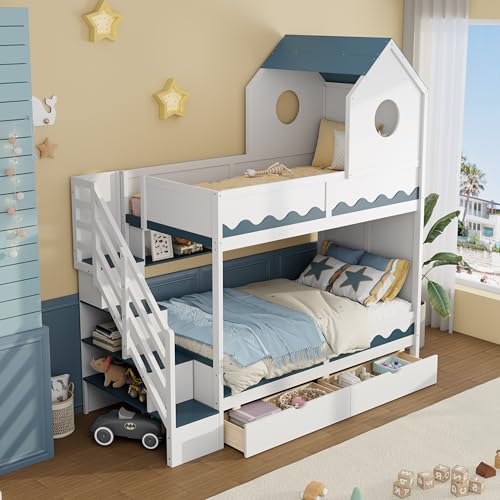
【Bold Color Contrast & Wave Texture】Choose from two vibrant color pairings—White + Blue or Pink + Gray—featuring a striking wave-textured side panel that elevates the look of any room with its modern and playful design.
Loft and Futon Bunks: Maximizing Floor Space
Since you’re figuring out how loft beds actually save space compared to bunk beds, here’s the core difference: a loft is a single elevated mattress with open, usable space underneath, while a bunk stacks a second mattress below. This creates prime real estate for a desk or storage.
That’s pure vertical optimization, turning dead air into a functional zone. Lofts free this area, needing at least 33 inches under the mattress top. Popular design variations like L‑shaped or modular loft beds can be configured to make the most of awkward room layouts. Now, futon bunks add convertible versatility. They pair an upper bed with a sofa that folds into a mattress, creating a lounge by day and a guest bed at night. This dual-purpose design lets you reclaim floor space. Your room serves multiple functions without feeling cramped. As a cost‑effective sleeping solution, it’s important to consider adequate ceiling height and sturdy construction for safety.
Can Adults Safely Use Bunk Beds?
You’ve seen how loft and futon bunks maximize space, but you might be wondering if those space-saving bunk beds are even an option for you as an adult.
Absolutely, but you must prioritize safety. You need to check the specific weight limits on any model. Look for a minimum of 250–300 lbs per bunk, with many sturdy designs supporting 350 lbs or more.
Here’s the thing: those limits depend entirely on construction stability. Seek out features like solid joinery, welded frames, and reinforced cross-members. This guarantees no wobbling under adult movement.
Your clear takeaway? Modern bunk beds are built for adults when you select the right, robust design. Next, you’ll want to know which features make the safest choice for daily use.
5 Key Factors for Choosing Your Bunk Bed
While you’re figuring out what bunk beds even look like, choosing the right one can feel overwhelming with all the options. Let’s simplify it with five key factors.
First, never compromise on verified safety certification like BS EN 747. That means guardrails on all top bunk sides and a proper ladder.
Next, consider age appropriateness. The top bunk isn’t for kids under six. You’ll also need the right mattress thickness—under 15cm for the top.
Now, evaluate materials. Solid wood beats particle board for long-term durability. Always measure your room’s ceiling height and floor space.
Finally, pick a size and style that fits your kids’ needs and grows with them. Your main takeaway? Start with safety and size, then build from there. Ready to measure your space?

SOLID PINE WOOD CONSTRUCTION — 77" L × 41" W × 60" H — Built from 100% solid pine wood throughout the frame, ladder, and guardrails. Substantial real-wood construction (96 lb total bed weight, per UL test report). Designed for daily use by kids, teens, and adult guests.

SOLID PINE WOOD CONSTRUCTION — 77" L × 41" W × 60" H — Built from 100% solid pine wood throughout the frame, ladder, and guardrails. Substantial real-wood construction (96 lb total bed weight, per UL test report). Designed for daily use by kids, teens, and adult guests.

TWIN OVER TWIN BUNK BED FOR KIDS: Twin over twin bunk bed with ladder; Convertible bunk bed can be transformed into 2 individual twin beds for maximum versatility; Designed to fit any standard twin mattress (mattresses not included); Assembly required