
What Is a Bunk Bed?
You’re right to ask — the name “bunk bed” is a bit vague. Simply put, it’s a stacked vertical sleeping setup that places two beds on one frame, saving a huge amount of floor space. Think of it like a vertical dorm room: it fits two sleepers in the footprint of just one bed. They’re essential in kids’ rooms, hostels, or any place where you need to maximize sleeping capacity smartly. Getting the basics down makes choosing one much easier later.
What Is a Bunk Bed in Simple Terms?
Obviously you’re looking for a clear-cut definition, not the fluff. A bunk bed is a sleeping setup that stacks two beds vertically on a single frame.
Think of it as a tall bed tower. It’s one bed frame directly above another. This saves a massive amount of floor space, which is why they are essential in dormitories and hostels. This design makes them a prime example of a space-saving solution for shared sleeping quarters.
You’ll see this simple, sturdy design everywhere from kids’ rooms to military history exhibits on barracks. It has four corner posts, a ladder, and safety rails on top.
It’s purely functional furniture, not a complicated crafts project. Its genius is in that vertical stacking. You get two sleep spots in one footprint.
Your takeaway: it’s efficient stacking for shared sleeping. Now, let’s see how it compares to its cousin, the loft bed. Beyond the traditional stacked configuration, there are also L-shaped and triple bunk beds for different needs.
How Does a Bunk Bed Differ From a Loft Bed?
While bunk beds and loft beds might look similar at first glance, here’s the core difference that changes everything: a bunk bed is designed for multiple sleepers, while a loft bed is built to free up floor space for a single sleeper.
You’re choosing between adding a bed or creating a room. A bunk’s lower space holds another mattress. That limits its customization limitations—you might only add drawers. A loft bed’s entire underside is free. You fit a desk, sofa, or shelving underneath. Many space-saving models include built-in storage solutions like drawers or desks to maximize functionality.
This defines their space optimization. Bunks maximize sleeping capacity in a shared kid’s room. Lofts optimize activity space in a studio or single room. You’re solving for people or square footage. This makes a loft bed a cost-effective sleeping solution that also creates a versatile area for work or play. Bunk beds are often a better choice for families navigating shared rooms or small apartments, where maximizing sleeping capacity is the priority. That clarity helps you pick your next step: considering room size and who’s sleeping there.
What Are the Common Types and Sizes of Bunk Beds?
You’ve nailed that bunk beds are for more people, so now you’re wondering about the different ways they can actually be arranged.
The classic Standard bunk stacks two twins vertically. L-Shaped beds position bunks perpendicularly, freeing up floor space and offering a versatile room layout(link). For three sleepers, Triple bunks stack high or arrange in an L, often needing tall ceilings, and these models are specifically designed to maximize sleeping capacity(link) in shared children’s rooms. When selecting a Triple bunk for adult use, pay close attention to the load-bearing capacity(link) and material durability. A Trundle bunk adds a pull-out bed underneath for guests.
You’ll find common sizes like twin-over-twin or twin-over-full for more lower bed space. Heights range from about 65 inches for a standard frame to over 78 inches for a triple.
Always check a model’s specific Weight Capacity and look for Safety Certifications like ASTM or CPSC—this info is vital regardless of type or size. Next, you’ll want to examine the specific features that guarantee safe use.
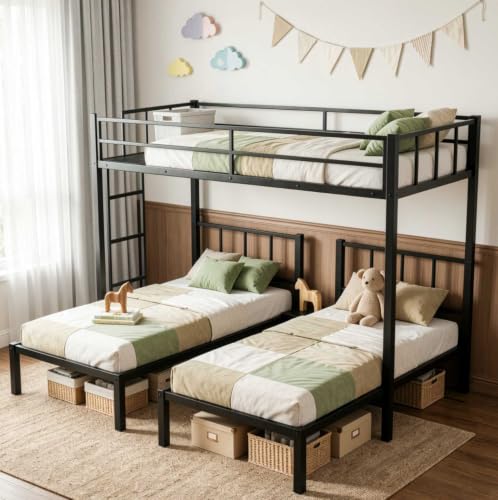
Versatile 3-in-1 Convertible Design for Evolving Needs: This triple bunk bed easily transforms from a stacked triple into three standalone beds (one Twin XL and two Twin). It adapts to changing living situations without replacing furniture, suits shared kids' rooms today and separate guest or teen rooms tomorrow

【Durable Heavy-Duty Metal Frame】Built from high-strength steel, this triple bunk bed supports multiple sleepers with exceptional stability. Reinforced metal slats and a scratch-resistant powder-coated finish ensure years of reliable use.
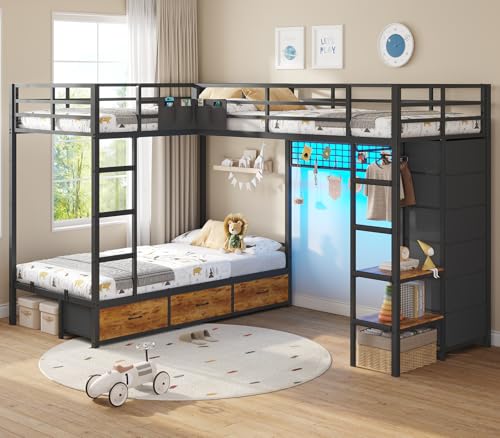
【Space-Saving 3-in-1 Bunk Bed】 This innovative L-shaped triple bunk bed provides two upper twin bunks and one lower twin bunk, fitting perfectly into corners and adapting to the layout of the room without taking up too much valuable floor space. Smart storage and LED lights are built in to keep the room both tidy and bright. Perfect for multiple-child families, dorm rooms, or guest spaces, this 3 bed bunk beds delivers comfort, privacy, and practicality—all in one.
What Key Features Make a Bunk Bed Safe and Functional?
Since you’re focused on safety features, it’s critical to know the key components that prevent accidents. You’ll want tight guardrail gaps—under 0.22 inches—so nothing can slip through and sturdy rails that extend five inches above the mattress. The ladder needs fixed, non-slip rungs with proper rung spacing of 10-12 inches for secure climbing. Now, the bed’s ends must block entrapment; you’ll check openings to prevent head or neck trapping. Obviously, you need a sturdy frame with rounded corners meeting safety standards like CPSC. Always perform a thorough stability assessment to detect wobble or looseness that could lead to failure. Finally, remember the top bunk’s minimum age is six and you must maintain a 30-inch ceiling clearance. Parents should also perform regular maintenance checks to ensure all components remain tight and secure over time. Always adhere to the manufacturer’s specified weight limit to prevent structural strain. Your main takeaway is that specific measurements and secure construction create a safe, functional bunk bed. Next, you’ll consider where these beds are most practical.

【STURDY METAL FRAME】This twin bunk beds made of strong steel construction with black powder coat finish; Weight limit of Lower bunk: 400 lb, Weight limit of Upper bunk: 400 lb; Optional wall-mounted bracket included to increase the stability of bed

【Upgraded Safety and Convenience】 14.2" high guardrails and a sturdy ladder ensure secure climbing. Designed with hanging hooks and storage pockets to keep the space tidy — bunk bed twin over twin for dorms, cabins, and vacation homes

【Enhanced Safety for Kids】This low loft bed features a 13.8" extended guardrail, a heavy-duty metal frame up to 400 lbs, rounded corners, anti-toppling device, and a wide ladder with soft foam padding makes climbing safer for little feet. Fits 4–6" mattresses to keep children securely in place through the night.
Where Are Bunk Beds Most Commonly Used?
Bunk beds solve a fundamental space problem, so it’s no wonder you’re wondering where they actually make the most sense. Obviously, you see them in kids’ bedrooms. They’re perfect for siblings sharing a room, freeing up floor space for play. But their use extends far beyond homes.
They’re essential in places where maximizing sleeping capacity is critical. You’ll find them in hostels, dormitories, and vacation rentals to accommodate more guests. Their setup in dorm rooms begins with a critical review of university policies and precise room measurements. A lofted dorm bed can free up floor space for a study area or personal lounge beneath it. In emergency housing and homeless shelters, they allow organizations to help more people. Military barracks use them for the same efficient, space-saving reason. They are also a valuable solution for multi‑generational households in rural villages seeking to improve housing quality affordably. They’re a practical solution wherever you need to fit more beds into a limited area.
Now, knowing where they’re used, your next question is likely how to pick a safe and suitable one for your own needs.
How to Choose a Bunk Bed: Safety, Size, and Style Checklist
Now, once you know where bunk beds work best, the real challenge is figuring out how to pick the right one for your home—and not get overwhelmed by all the options. Let’s start with your most important job: safety.
What’s the safety checklist?
Your top bunk needs guardrails on all sides, with gaps narrower than 3.5 inches. Guarantee its mattress fits snugly, leaving at least 5 inches of rail above it. Always check posted weight limits for proper weight distribution, and only let kids six and older use the top. Look for certification labels (ASTM F-1427) too. The required guardrail height can vary based on your mattress thickness to ensure a safe five-inch barrier remains.
Will it fit your room and your kids?
Start with careful space planning. Measure your ceiling height first. You need two feet of clearance above the top mattress. Obviously, taller kids need more headroom in the lower bunk. Choose a bed style—like a low-profile or loft model—that fits those dimensions. For example, a standard twin-over-twin configuration is typically about 38 inches wide and 75 inches long per bed, with a total structure height of 60 to 70 inches. Comparing pros and cons for each model will help you balance these practical needs with design preferences.
So, what’s your first step?
Grab a tape measure. Check your room’s height and floor space, then review age and weight specs. That clarity narrows your search instantly.

Engineered for Maximum Protection – Dual pre fixed length options (35.5″ or 47″) and 14 precise height levels for a secure, gap-free fit on any bed.

SOLID PINE WOOD CONSTRUCTION — 77" L × 41" W × 60" H — Built from 100% solid pine wood throughout the frame, ladder, and guardrails. Substantial real-wood construction (96 lb total bed weight, per UL test report). Designed for daily use by kids, teens, and adult guests.

SOLID PINE WOOD CONSTRUCTION — 77" L × 41" W × 60" H — Built from 100% solid pine wood throughout the frame, ladder, and guardrails. Substantial real-wood construction (96 lb total bed weight, per UL test report). Designed for daily use by kids, teens, and adult guests.
What Are the Pros and Cons of Owning a Bunk Bed?
Maybe you’re wondering if a bunk bed’s space-saving magic is worth the trade-offs—it’s a smart question before you plunge ahead.
Your main pro is obvious: you reclaim precious floor space. That single footprint creates room for play or a desk. It’s a budget-friendly solution for two sleepers, too. Before committing, always verify the weight limits for both the frame and mattress to ensure it meets the needs of the intended sleepers.
But safety is your biggest con. Top bunks pose a real fall risk, especially for young kids. Your Material Selection is critical—sturdy hardwoods or solid metal matter more than price. Assembly Precision is non-negotiable; a wobbly frame is a hazard.
You also trade some comfort. Top sleepers get limited headroom, and bottom sleepers might feel enclosed. You should also consider whether the setup will work for younger children or anyone with limited mobility.
Can a Bunk Bed Be Separated Into Two Individual Beds?
Absolutely — if you’re picturing a future where your kids need their own beds, you’ll be glad to know many bunk beds are specifically designed to split apart.
How do you actually separate a bunk bed?
The conversion mechanics are straightforward. You’ll typically unscrew bolts or brackets at the key connection points. Start by removing guardrails and ladders. Then, you disconnect the metal sleeves joining the two frames. This often involves lifting the top bunk slightly to clear the connection sleeves.
What are the main separation methods?
Some models use simple gravity-lock systems for standalone use. Others might require a rubber mallet to swap headboards. It’s a clear, reversible process. You’re left with two individual twin beds, maximizing your room’s flexibility for years.

🥇【Twin over Twin Bunk Beds:Space-saving 】Designed to maximize vertical space, this twin over twin bunk bed is perfect for shared bedrooms, guest rooms, apartments, or growing families. The compact design provides comfortable sleeping space for multiple kids or teens while freeing up valuable floor space for play, study, or storage.

TWIN OVER TWIN BUNK BED FOR KIDS: Twin over twin bunk bed with ladder; Convertible bunk bed can be transformed into 2 individual twin beds for maximum versatility; Designed to fit any standard twin mattress (mattresses not included); Assembly required

TWIN OVER TWIN BUNK BED FOR KIDS: Twin over twin bunk bed with ladder; Convertible bunk bed can be transformed into 2 individual twin beds for maximum versatility; Designed to fit any standard twin mattress (mattresses not included); Assembly required
Essential Bunk Bed Maintenance and Care Tips
Thinking about bunk bed upkeep is smart—it’s the key to making this hardworking piece of furniture last.
You’ll want to establish a simple routine. Tighten all bolts every three to six months to stop shaking. Inspect the ladder and rails then, too. Clean frames weekly and do a deeper monthly wash.
Seasonal adjustments matter. Wood can swell or contract. Maintain room humidity between 40-60%. Use a dehumidifier in summer.
Got pets? Those are pet considerations. Trim claws to minimize scratches on wood. Wipe drool or accidents immediately to protect the finish.
Rotate mattresses every six months for even wear. Check for frame cracks monthly. This proactive care prevents most problems.
Your clear next step is setting a calendar reminder for that first hardware check. Consistency is everything.

Products Hardware Kit: This set includes M6 crib screws in 4 lengths (20mm, 40mm, 60mm, 80mm) along with matching barrel nuts and wrenches for assembling cribs, bunk beds, headboards, and other furniture.

Exquisite Material: The hardware replacement kit is made of high-quality carbon steel, color zinc, which has high hardness, corrosion resistance, rust resistance, not easy to be damaged or broken, strong and durable.

Crib Screws Hardware Replacement Kit(with Barrel Nuts/Dowel Pins/Hex Wrenches);Type: Socket Head Screws